Expert Foundations for Strengthening the Management and Maintenance of Green Spaces and Urban Trees
Expert foundations for strengthening the effects of planning and managing green spaces were prepared on behalf of the Ministry of Natural Resources and Spatial Planning by representatives of LUZ, d.d., IPoP – Institute for Spatial Policies, and PIC – Legal Network for the Protection of Human Rights and the Environment. The task includes a study on the effectiveness of planning green spaces and trees in spatial acts, a proposal for uniform criteria and conditions for management and maintenance, a review of the legal framework with proposals for amendments and upgrades, and proposals for training stakeholders in the field of managing green spaces and trees in settlements. The task is the result of the Ministry’s efforts to improve the effectiveness of planning and managing green spaces and trees in settlements.
The three partner organizations divided the work appropriately so that LUZ d.d. took on the leadership and coordination of the work and the section dedicated to verifying planning effectiveness, IPoP took on the management section, and PIC took on the legal framework.
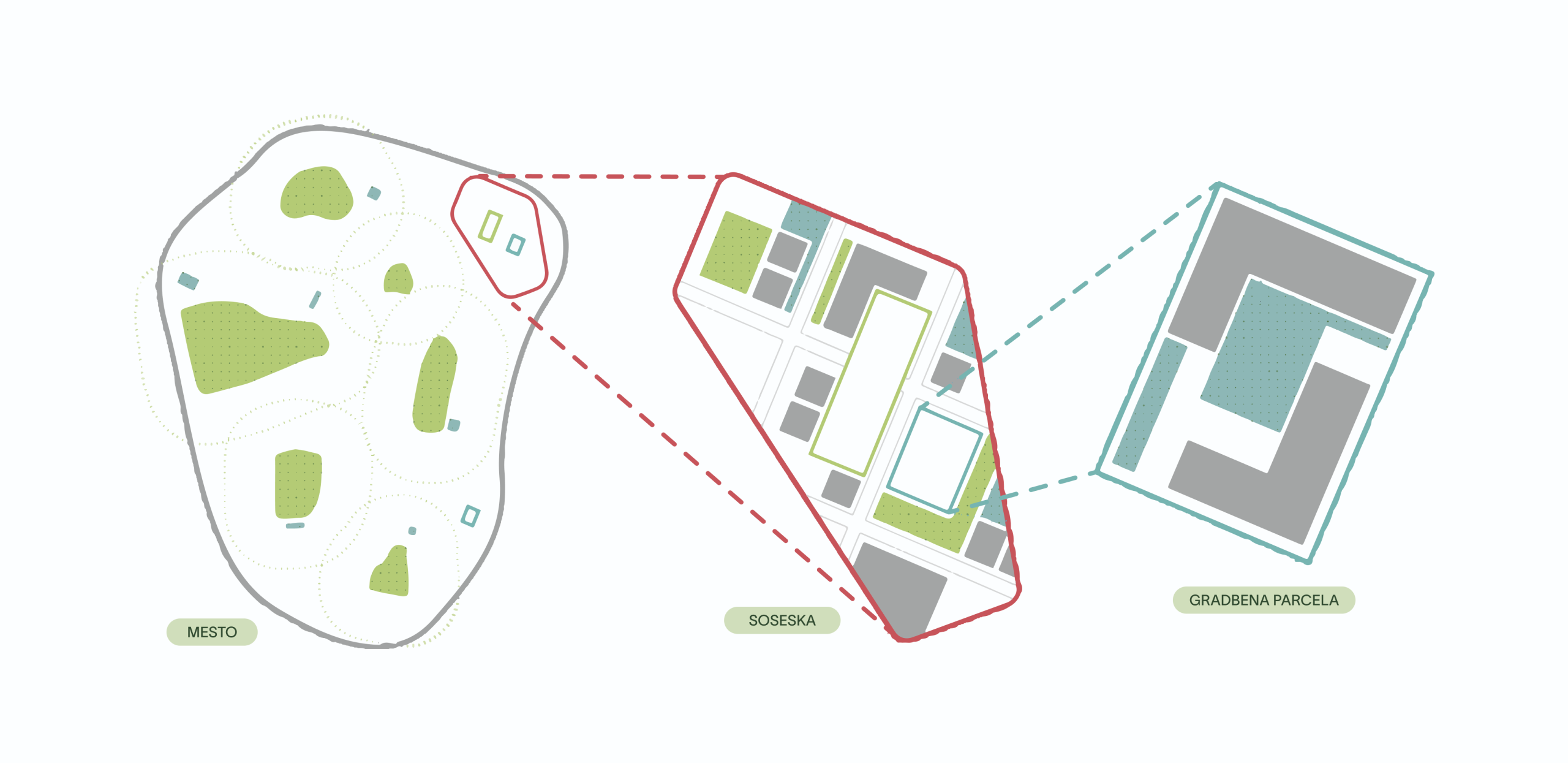
In the first section, LUZ, d.d. examined how effectively planning principles and recommendations regarding the protection of existing and provision of new green spaces and trees are implemented from the strategic to the implementation level. The effectiveness assessment is based on current international and national strategic guidelines and recommendations. The analysis of spatial planning provisions was carried out to assess the effectiveness of existing provisions in relation to the current state, as well as to propose improvements, and included a preliminary analysis of urban designs and municipal spatial plans (OPN); a detailed analysis of provisions in selected municipal spatial plans; and the implementation of focus groups to verify the appropriateness of provisions and proposals for upgrades.
During the preparation of the detailed analysis and the preparation of the “baseline state” of green spaces, verification of the accessibility and adequacy of data for analyzing the provision of selected settlements with green spaces and trees (i.e., “what to measure with,” which data are relevant for monitoring the state, in accordance with the Nature Restoration Regulation) emerged as a necessary (secondary) objective. One of the key messages of this part of the task is that designated land use is the most effective method of spatial planning, as it most directly protects green spaces. Detailed criteria and conditions for the protection and development of green spaces in other designated land uses are determined in various ways and primarily less effectively. Analysis of some implemented projects shows that despite requirements to maintain shares of green (vegetated) surfaces, the desired state is often not achieved. The task therefore also addresses the phase of open space design, where there is an evident lack of conditions for effective and professionally competent design and implementation of new developments and renovations.
In general, OPN provisions should more consistently include requirements for managing green spaces that are key in the city network, in the green system network (either as designated land uses or as provisions in the OPN), which is why the task presents proposals for supplementing and upgrading spatial planning provisions or supplementing the existing system with new tools, but above all, the message of the task is that timely cooperation of stakeholders in all phases of development is essential, with professional supervision of the implementation of works also being necessary.